
Custom Italian Kitchen Cabinet Pricing: A 2026 Guide
Table of Contents
- What Drives Custom Italian Kitchen Cabinet Pricing
- Bespoke Kitchen Design Costs: Breaking Down the Investment
- Italian Kitchen Cabinet Materials and Finishes
- Bespoke Kitchen Installation Timeline and Labour Costs
- Total Cost of Ownership: Beyond the Initial Purchase
- Customisation Options and Their Cost Impact
- Conclusion
- Frequently Asked Questions
Last Updated: August 29, 2026
What Drives Custom Italian Kitchen Cabinet Pricing
Custom Italian kitchen cabinet pricing reflects far more than material costs. The real drivers are craftsmanship, import logistics, bespoke design complexity, and the labour required to transform raw materials into handcrafted pieces that define a room.
At ItaliaHome, we've observed that most UK homeowners underestimate how many variables influence the final cost. They see a price per linear foot online and assume that's the total. It rarely is. A truly bespoke kitchen involves specification work, factory coordination, shipping timelines, and installation coordination that each add layers to the investment.
The primary factors shaping custom Italian kitchen cabinet pricing include material selection, finish complexity, customisation depth, import duties and logistics, installation labour, and project timeline. Each of these compounds the others. A lacquer finish on walnut veneer costs more than a simple laminate. A kitchen island with integrated appliances costs more than standard base units. A tight timeline costs more than a relaxed one.
Understanding these drivers helps you budget accurately. Rather than fixating on a single price figure, think in terms of total project cost. This includes the cabinetry itself, delivery and handling, installation labour, any bespoke hardware, and contingency for unforeseen site adjustments. Most renovation budgets fail because they account for only the cabinet purchase price, not the ecosystem around it.
Bespoke Kitchen Design Costs: Breaking Down the Investment
Bespoke kitchen design costs depend on whether you're selecting from modular systems or commissioning entirely custom pieces. The distinction matters enormously for your budget.
Modular systems from established Italian manufacturers offer fixed pricing within defined ranges. You choose dimensions, finishes, and hardware from available options, then the factory assembles to specification. This approach typically costs between £8,000 and £25,000 for a complete kitchen, depending on size, material grade, and finish complexity. A small galley kitchen with standard finishes sits toward the lower end. A large open-plan kitchen with premium lacquer finishes and integrated appliances sits toward the upper end.
Fully bespoke design, where the kitchen is conceived specifically for your space, your workflow, and your aesthetic, operates differently. There's no fixed menu. The design process itself incurs costs. Architectural consultation, 3D rendering, site surveys, and specification engineering add £2,000 to £6,000 before a single cabinet is built. Then manufacturing begins, factoring in custom dimensions, unusual angles, integrated storage solutions, and specialist finishes.
The real cost driver in bespoke work is labour, both design labour and manufacturing labour. A kitchen designed around an awkward corner, low ceilings, or unusual appliance placement requires problem-solving that standard modular systems cannot accommodate. The factory must engineer solutions. That engineering costs money.
Installation labour in the UK typically ranges from £3,000 to £8,000 depending on kitchen complexity, site access, and the extent of structural or electrical work required. A straightforward replacement in an accessible kitchen costs less. A kitchen requiring new plumbing runs, electrical rewiring, or structural modifications costs significantly more. Many homeowners budget for cabinetry but underestimate installation labour, only to face a painful surprise on site.
Italian Kitchen Cabinet Materials and Finishes
Italian kitchen cabinet materials define both aesthetics and durability. The choices available, and their cost implications, range considerably.
Lacquer and Veneer Options
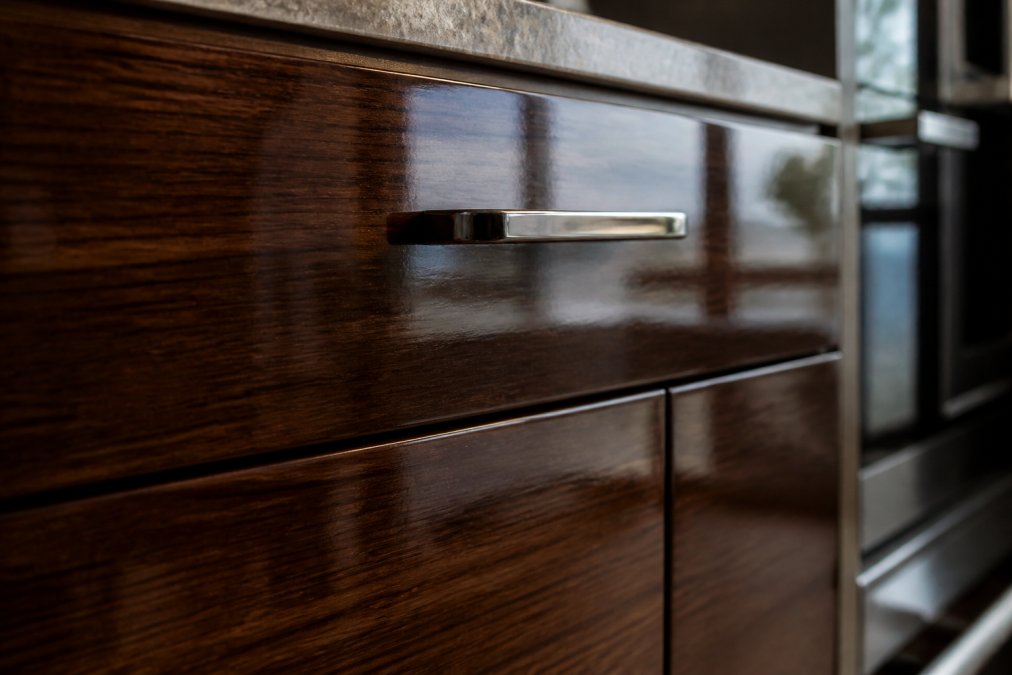
Lacquer finishes represent the premium tier of Italian kitchen cabinet materials. Lacquer is a hard, glossy coating applied in multiple layers over a substrate, typically MDF or plywood, then veneered with solid wood or high-quality veneer. The process requires precision: each layer must cure, be sanded, and be inspected before the next layer is applied. A single lacquer finish involves five to eight coats. This labour intensity drives cost.
Lacquer finishes deliver superior durability and aesthetic depth compared to simpler alternatives. The finish resists moisture, scratches, and staining better than paint or basic veneer. Colours appear richer because light penetrates multiple layers. High-gloss lacquer in white, black, or neutral tones creates the contemporary Italian aesthetic that appeals to UK homeowners seeking modern elegance.
The trade-off is maintenance. Lacquer requires regular cleaning with appropriate products, harsh chemicals or abrasive cloths damage the finish. Over 10-15 years, high-gloss lacquer may show micro-scratches or require professional refinishing in heavy-use areas.
Veneer alternatives offer cost savings. Veneer is a thin layer of real wood applied to a substrate. It provides authentic wood appearance at lower cost than solid wood construction. Veneer quality varies: premium veneers from rare or figured wood cost more; standard veneers cost less. Veneer is less durable than lacquer in moisture-rich environments like kitchens, but when properly sealed and maintained, it performs well.
Premium Hardware and Ergonomic Design
Cabinet hardware represents both functional necessity and design statement. Italian manufacturers distinguish themselves through hardware selection and integration.
Premium hinges, drawer runners, and handles account for 8-15% of total cabinetry cost. Blum and Hettich are industry standards, offering soft-close mechanisms that prevent slamming and extend hardware lifespan. Soft-close hinges cost more than standard hinges but reduce wear and noise over years of use.
Ergonomic design, the layout and accessibility of storage, influences both function and cost. Pull-out drawers, corner carousel systems, and vertical dividers for baking trays or chopping boards require engineering and custom installation. These features cost more to manufacture and install than simple fixed shelving, but they transform how a kitchen functions in daily use.
Height customisation for different household members, accessible storage for mobility-limited users, and workflow optimisation around appliance placement all reflect bespoke design thinking. These aren't standard modular options; they're custom solutions that justify premium pricing because they solve real problems in real kitchens.
Bespoke Kitchen Installation Timeline and Labour Costs
Bespoke kitchen installation timeline directly influences labour costs. A compressed timeline, delivering and installing within 4-6 weeks, requires expedited manufacturing, priority shipping, and coordinated site labour. This costs significantly more than a relaxed 12-16 week timeline.
Standard timelines work like this: specification and design approval takes 2-4 weeks. Manufacturing takes 6-10 weeks depending on finish complexity and current factory capacity. Shipping from Italy to the UK takes 2-3 weeks. Site preparation and installation takes 2-4 weeks. Total elapsed time is typically 12-20 weeks from order to completion.
Compressed timelines require premium freight (air or priority sea shipping instead of standard container consolidation), factory overtime, and coordinated installation crews. Budget an additional £1,500 to £3,000 for expedited delivery and installation if your project timeline is tight.
Labour costs reflect site complexity. A straightforward installation in a modern kitchen with good access, existing utilities in the right locations, and minimal structural work costs less than a kitchen requiring new plumbing, electrical rewiring, or structural modifications. Tradespeople (electricians, plumbers, builders) may be required alongside cabinet installers, multiplying labour costs.
Many homeowners discover during installation that site conditions differ from initial survey. A wall isn't plumb. Existing utilities are in unexpected locations. Structural elements require work. These discoveries trigger change orders and additional labour costs. Budget 10-15% contingency for installation surprises.
Total Cost of Ownership: Beyond the Initial Purchase
Total cost of ownership for custom Italian kitchen cabinetry extends well beyond the purchase price. Maintenance, durability expectations, and long-term care shape the true investment.
Maintenance costs vary by finish. Lacquer requires regular cleaning with pH-neutral products and occasional professional polishing. Veneer requires less frequent intervention but may need refinishing after 10-15 years of heavy use, costing £1,500-3,000 depending on extent.
Durability differs by material grade. Premium Italian cabinetry from established manufacturers typically lasts 15-25 years with proper maintenance. Cheaper alternatives may show wear after 8-10 years. Over a 20-year ownership period, a durable cabinet system costs less per year than a cheaper system requiring earlier replacement.
Resale value impact is significant but often overlooked. A kitchen featuring bespoke Italian cabinetry with quality finishes and thoughtful design appeals to future buyers and justifies premium property valuations. Conversely, a kitchen with worn, dated, or poorly specified cabinetry depresses property value. In the UK property market, kitchen quality influences buyer perception disproportionately. A well-executed bespoke Italian kitchen can recover 60-80% of its cost through increased property value. A mediocre kitchen recovers 30-40%.
Consider the full 20-year cost picture: initial purchase (£15,000-40,000), annual maintenance, potential refinishing at year 15 (£1,500-3,000), and resale value uplift. The premium Italian option often proves more economical than cheaper alternatives when viewed over the full ownership horizon.
Customisation Options and Their Cost Impact
Customisation options transform a kitchen from standard to bespoke, and each option adds cost proportionally to its complexity.
Dimension customisation, building cabinets to fit your exact space rather than selecting from standard sizes, is foundational to bespoke work. A kitchen with an unusual ceiling height, sloped wall, or awkward corner requires custom engineering. This costs more than modular systems but ensures the kitchen fits perfectly and functions as designed.

Integrated appliances, where ovens, hobs, and refrigeration are seamlessly incorporated into the cabinetry, require precise specification and coordination. Standard modular kitchens accommodate appliances in fixed locations. Bespoke kitchens can position appliances anywhere, including islands or unusual wall configurations. This flexibility costs more because it requires custom engineering and site-specific installation.
Storage solutions beyond standard shelving, pull-out larders, corner carousel systems, vertical dividers for baking trays, integrated spice racks, add functionality but increase cost. Each custom storage solution requires engineering, custom manufacturing, and careful installation. Budget £500-1,500 per custom storage feature.
Finish variations across the kitchen, mixing lacquer and veneer, combining colours, incorporating glass or metal accents, increase manufacturing complexity. A monochromatic kitchen with uniform finish costs less than a kitchen with varied finishes. Each finish variation requires separate production runs, quality control, and assembly coordination.
Island customisation is particularly cost-intensive. A kitchen island that matches the main cabinetry, includes integrated seating, incorporates storage, and accommodates plumbing or electrical services requires substantial engineering. Budget £6,000-15,000 for a fully customised island depending on size and complexity.
The relationship between customisation and cost is roughly linear: each custom element adds proportional cost. A kitchen with five custom features costs roughly 25-35% more than an equivalent modular kitchen. A kitchen with ten custom features costs 50-70% more. Understanding this relationship helps you prioritise which customisations matter most for your needs and budget.
Conclusion
Custom Italian kitchen cabinet pricing reflects genuine complexity: craftsmanship, import logistics, bespoke design, installation coordination, and long-term durability. The investment is substantial, but when viewed across 15-20 years of ownership, the cost per year often proves competitive with cheaper alternatives that require earlier replacement or fail to deliver the aesthetic and functional benefits.
ItaliaHome specialises in handcrafted Italian kitchen solutions designed specifically for UK homeowners seeking bespoke design and exceptional quality. Our partnerships with renowned Italian manufacturers like Spar ensure that every project combines traditional craftsmanship with contemporary design. We handle specification, import coordination, and installation support, transforming your kitchen vision into reality. ENQUIRE today to discuss your bespoke kitchen project and receive a detailed cost breakdown tailored to your space and requirements. Explore our Spar Custom Kitchens collection to see how Italian cabinetry can elevate your home.

| Customisation Element | Cost Impact | Best For |
|---|---|---|
| Dimension customisation | +£2,000-5,000 | Unusual layouts, sloped walls, low ceilings |
| Integrated appliances | +£1,500-4,000 | Modern workflows, island placement |
| Premium lacquer finish | +£3,000-8,000 | Contemporary aesthetics, durability priority |
| Custom storage solutions | +£500-1,500 per feature | Specific storage needs, workflow optimisation |
| Kitchen island | +£6,000-15,000 | Open-plan layouts, seating integration |
| Soft-close hardware | +£800-2,000 | Noise reduction, extended lifespan |
| Expedited timeline | +£1,500-3,000 | Compressed project schedules |
According to UK government guidance on home improvement VAT, kitchen renovations may qualify for VAT relief under specific circumstances, verify your eligibility before finalising your budget.
Research from Which? home improvement survey found that kitchen quality significantly influences buyer perception during property sales, with well-executed kitchens recovering 60-80% of investment through increased property value.
The British Institute of Kitchen, Bedroom & Bathroom Installers standards provides installation best practices and installer accreditation, helping homeowners identify qualified professionals for complex bespoke projects.
Frequently Asked Questions
Q: How much does custom Italian kitchen cabinet pricing typically cost per linear foot?
A: Custom Italian kitchen cabinet pricing ranges from £800 to £3,000+ per linear foot, depending on materials, finishes, and customisation complexity. Entry-level bespoke designs start around £800-£1,200 per linear foot, mid-range options sit between £1,500-£2,200, and luxury, fully customised installations exceed £2,500 per linear foot. Spar Modern Kitchens, for example, exemplify the mid-to-premium tier with innovative design and superior material quality. Your final cost depends on cabinet depth, finish type (lacquer versus veneer), hardware selection, and any architectural customisation needed for your kitchen layout.
Q: What factors influence the price of bespoke kitchen design costs most significantly?
A: The primary cost drivers are material grade, finish complexity, customisation scope, and installation labour. Premium lacquer finishes cost more than veneer; hand-selected hardware adds £50-£200 per cabinet; and non-standard dimensions for awkward layouts or kitchen islands increase manufacturing time and cost. Import logistics from Italy, lead time (typically 12-16 weeks), and on-site installation labour also substantially impact total project cost. Specification details, such as ergonomic drawer systems, integrated lighting, or bespoke cabinetry for unusual spaces, further influence pricing.
Q: How long does a bespoke kitchen installation timeline typically take?
A: Expect 12-16 weeks from order confirmation to delivery, plus 2-4 weeks for on-site installation and finishing work. Manufacturing lead time accounts for the majority; Italian craftsmen produce each piece to specification rather than from stock. Installation labour depends on your kitchen's complexity, a straightforward rectangular layout takes 2-3 weeks, whilst awkward corners, islands, or integrated appliances extend the timeline to 4-6 weeks. Coordinating with electricians and plumbers for utility connections may add another 1-2 weeks. Plan your project timeline accordingly, especially if you have a specific completion date in mind.
Q: Are Italian kitchen cabinets worth the higher price compared to standard fitted kitchens?
A: Italian kitchen cabinets offer superior durability, aesthetic value, and long-term cost of ownership. Handcrafted construction using premium materials and finishes resists wear far longer than mass-produced alternatives; many pieces last 20+ years with proper maintenance. The resale value impact is significant, luxury kitchen upgrades typically recover 60-80% of investment at sale. Additionally, bespoke customisation ensures perfect fit for your space, eliminating costly retrofits or compromises. If you plan to stay in your home long-term and value craftsmanship and design, the premium investment pays dividends through durability, functionality, and home value appreciation.
This article was written using GrandRanker